A Beginner's Guide to Google, SEO, AI & Modern Digital Marketing
Introduction
When I first started learning digital marketing, one question kept coming to my mind:
"How does Google decide which website appears first?"
Whenever I searched for something like "best restaurant near me" or "best digital marketing course", thousands of websites appeared within seconds. Some websites ranked at the top, while others were buried on later pages.
At first, I thought businesses could simply pay Google to appear first. While paid advertisements do exist, I soon learned that most search results earn their rankings through a process called Search Engine Optimization (SEO).
The more I explored, the more I realized that Google isn't trying to promote the biggest company—it wants to provide users with the most useful and trustworthy information.
In this blog, I'll share what I've learned about how search engines work, how customers discover businesses online, and why SEO has become one of the most valuable skills in digital marketing.
Why Google Matters
Think about your own daily habits.
When you need an answer, where do you go?
Most people search Google before making a decision.
Whether it's:
- Finding a nearby café
- Buying a laptop
- Choosing a hotel
- Hiring a plumber
- Learning a new skill
Google has become the starting point of the customer journey.
If your business appears when people are searching, you have a much better chance of attracting new customers.
How Google Search Works
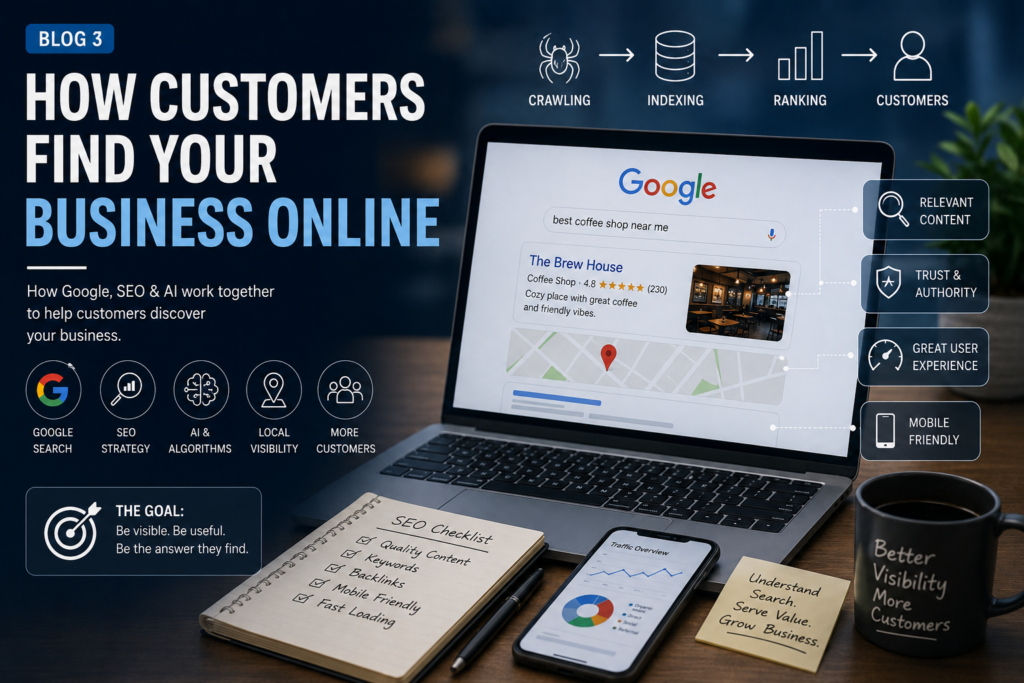
Google's search engine works in three major stages.
1. Crawling
Google uses automated programs called crawlers (or spiders) to discover new web pages.
These crawlers move from one page to another by following links across the internet.
Whenever you publish a new blog or update your website, Google's crawler may eventually discover it.
Think of crawling as someone walking through a giant library and collecting every book they can find.
2. Indexing
After Google discovers a page, it tries to understand what it's about.
It analyzes:
- Titles
- Images
- Content
- Videos
- Keywords
- Headings
If the page provides useful information, Google stores it in its massive database called the index.
This process is similar to placing a book into the correct section of a library.
3. Ranking
When someone performs a search, Google doesn't search the internet in real time.
Instead, it searches its index and decides which pages are most useful for that search.
It considers hundreds of ranking signals, including:
- Relevance
- Content quality
- User experience
- Website speed
- Mobile friendliness
- Authority
- Freshness of content
The goal is simple:
Give users the best possible answer.
What is SEO?
SEO stands for Search Engine Optimization.
It's the process of improving your website so search engines can better understand it and recommend it to users.
Good SEO isn't about tricking Google.
It's about creating helpful content that answers people's questions.
Understanding Keywords
Keywords are the words or phrases people type into Google.
For example:
- Best pizza in Kochi
- Affordable laptops
- Digital marketing course
- Wedding photographer near me
Choosing the right keywords helps search engines understand your content.
However, one thing I've learned is that using the same keyword repeatedly doesn't improve rankings.
Instead, content should read naturally while answering the user's question.
Search Intent
One concept I found particularly interesting is search intent.
Google doesn't just look at the words people type.
It also tries to understand why they are searching.
For example:
Someone searching:
"What is SEO?"
wants to learn.
Someone searching:
"Buy Nike running shoes"
is probably ready to make a purchase.
Understanding search intent helps businesses create more useful content.
On-Page SEO
On-page SEO refers to everything you can improve on your own website.
This includes:
- Clear headings
- Helpful content
- Optimized images
- Internal links
- Meta descriptions
- Title tags
- Easy navigation
Good on-page SEO improves both user experience and search visibility.
Off-Page SEO
Off-page SEO focuses on building your website's reputation.
One of the biggest factors is backlinks.
A backlink is when another website links to yours.
Think of it as a recommendation.
If many trusted websites mention your content, Google sees your website as more credible.
Quality matters much more than quantity.
Technical SEO
Technical SEO focuses on how well your website functions.
Important factors include:
- Website speed
- Secure HTTPS connection
- Mobile responsiveness
- Clean website structure
- XML sitemap
- Broken links
Visitors expect websites to load quickly.
If a website is slow or difficult to use, people usually leave—and Google notices that behavior.
EEAT: Building Trust Online
Google values websites that demonstrate:
- Experience
- Expertise
- Authoritativeness
- Trustworthiness
This is often referred to as EEAT.
For example, businesses that provide accurate information, showcase real experience, and maintain trustworthy websites are more likely to build credibility with both users and search engines.
The Role of Helpful Content
One of the biggest lessons I've learned is that Google rewards content written for people—not for search engines.
Helpful content should:
- Answer questions clearly.
- Solve problems.
- Be original.
- Be easy to read.
- Stay up to date.
When readers benefit from your content, search engines are more likely to recommend it.
AI and the Future of Search
Artificial Intelligence is changing how people search for information.
Today, AI can summarize answers, recommend content, and personalize search experiences.
Instead of replacing SEO, AI is encouraging businesses to create even better content.
As digital marketers, we should focus on producing information that's accurate, useful, and genuinely valuable.
Social Media Algorithms
Google isn't the only platform that uses algorithms.
Social media platforms also decide which content people see.
Instagram often prioritizes content based on:
- Engagement
- Watch time
- Saves
- Shares
- User interests
LinkedIn values:
- Professional discussions
- Meaningful comments
- Helpful insights
- Original content
YouTube
YouTube looks at:
- Watch time
- Audience retention
- Click-through rate
- Viewer satisfaction
Across all platforms, one pattern remains the same:
Content that genuinely helps people tends to perform better over time.
Voice Search
Many people now use voice assistants to search online.
Instead of typing:
"Best coffee shop."
They ask:
"What's the best coffee shop near me?"
This means businesses should create content that answers natural, conversational questions.
Common SEO Mistakes
As I've continued learning, I've noticed several mistakes beginners often make.
- Publishing content without research.
- Ignoring mobile users.
- Using too many keywords.
- Buying poor-quality backlinks.
- Forgetting to update old content.
- Expecting immediate results.
SEO is a long-term strategy built on consistency and quality.
Tips for Small Business Owners
If you're just getting started:
- Create a simple, mobile-friendly website.
- Keep your business information accurate.
- Publish helpful blog content regularly.
- Encourage satisfied customers to leave reviews.
- Learn the basics of SEO before spending heavily on ads.
- Focus on solving customer problems rather than chasing rankings.
What I've Learned
Learning how Google works completely changed the way I think about digital marketing.
I used to believe ranking higher meant finding shortcuts or using clever tricks. Instead, I discovered that search engines reward businesses that consistently provide helpful, trustworthy, and valuable information.
As I continue learning, one lesson stands out above all: successful marketing isn't about trying to outsmart algorithms—it's about understanding people and creating content that genuinely helps them.
Frequently Asked Questions
Can a small business rank on Google?
Yes. Small businesses can compete successfully by creating helpful content, optimizing their websites, and focusing on local SEO.
How long does SEO take?
SEO usually takes several months before significant improvements become visible. Consistency is more important than speed.
Is AI replacing SEO?
No. AI is changing how search works, but SEO remains essential because search engines still rely on high-quality, trustworthy content.
Should I focus on Google or social media?
Both are important. Google helps customers discover your business through search, while social media helps build relationships and engage your audience.
Final Thoughts
The internet has changed how people discover businesses, compare products, and make buying decisions. Today, being visible online is no longer optional—it's an important part of building trust and reaching new customers.
As a digital marketing student, learning about Google, SEO, and AI has shown me that successful marketing is not about finding shortcuts. It's about understanding how people search, creating meaningful content, and continuously improving the experience you provide.
Technology will continue to evolve, but businesses that focus on helping their customers, sharing valuable information, and adapting to change will always have an advantage.
Thank you for reading this three-part series. I hope these articles have made marketing and digital marketing feel less intimidating and more approachable. Like me, you're always learning—and that's one of the most exciting parts of this field.